
Trinity County Criminal Court Cases
Trinity County criminal court cases do not all land at the same counter. The 258th and 411th Judicial District Courts hear Trinity County felony prosecutions, and the Trinity County District Clerk keeps those files. The constitutional Trinity County Court handles the Class A and Class B misdemeanor jurisdiction assigned by Texas law. Its files are maintained by the Trinity County Clerk. Trinity County has no statutory county court at law, so a searcher should not wait for a file to appear in a court that does not exist here.
Trinity County fine-only cases take a third route. Four Trinity County justice courts handle matters filed in their precinct jurisdiction, while the Trinity County municipal courts in Trinity and Groveton keep city ordinance, traffic, and Class C files brought there. The Trinity County filing agency and place of the alleged offense help identify the court. A Trinity County payment page may show that money is due, but it does not replace the complaint, docket, judgment, or dismissal order.
Two Trinity County Felony Courts
The two district courts serve multi-county judicial districts, yet their Trinity County felony records have one local custodian. Contact the Trinity County District Clerk at 219 W. First Street, P.O. Box 549, Groveton, TX 75845, or call 936-642-1118. Give the full name, an approximate filing year, and the Trinity County cause number when known. Ask for the Trinity County register of actions or docket first. That index identifies the case and shows which named papers can be requested.
The official Trinity County clerk page is also the source for records-request and fee links.
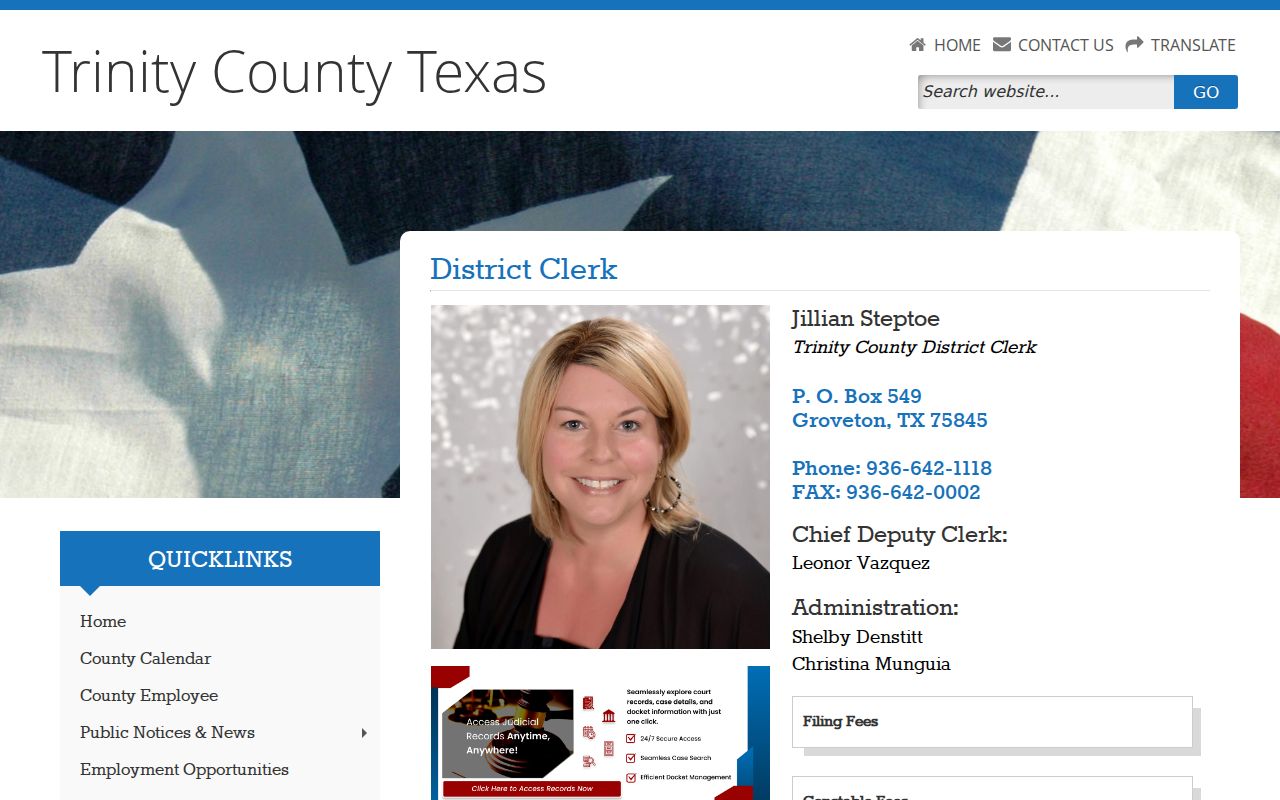
This Trinity County channel matters when a statewide result lacks a document, an older file has not been digitized, or a certified disposition is needed.
Trinity County Filed Charge Trail
The Trinity County prosecutor decides what charge to file after the arrest record is made. The Trinity County District Attorney handles felony prosecution from the courthouse Rock Building, while the County Attorney fills the Trinity County office role for misdemeanor matters. Those Trinity County prosecution offices make filing decisions, but they are not public case-search services. The Trinity County clerk, not the prosecutor, is the custodian for the public docket and filed court papers.
The official Trinity County District Attorney page identifies the Rock Building and victim-services contact channel.
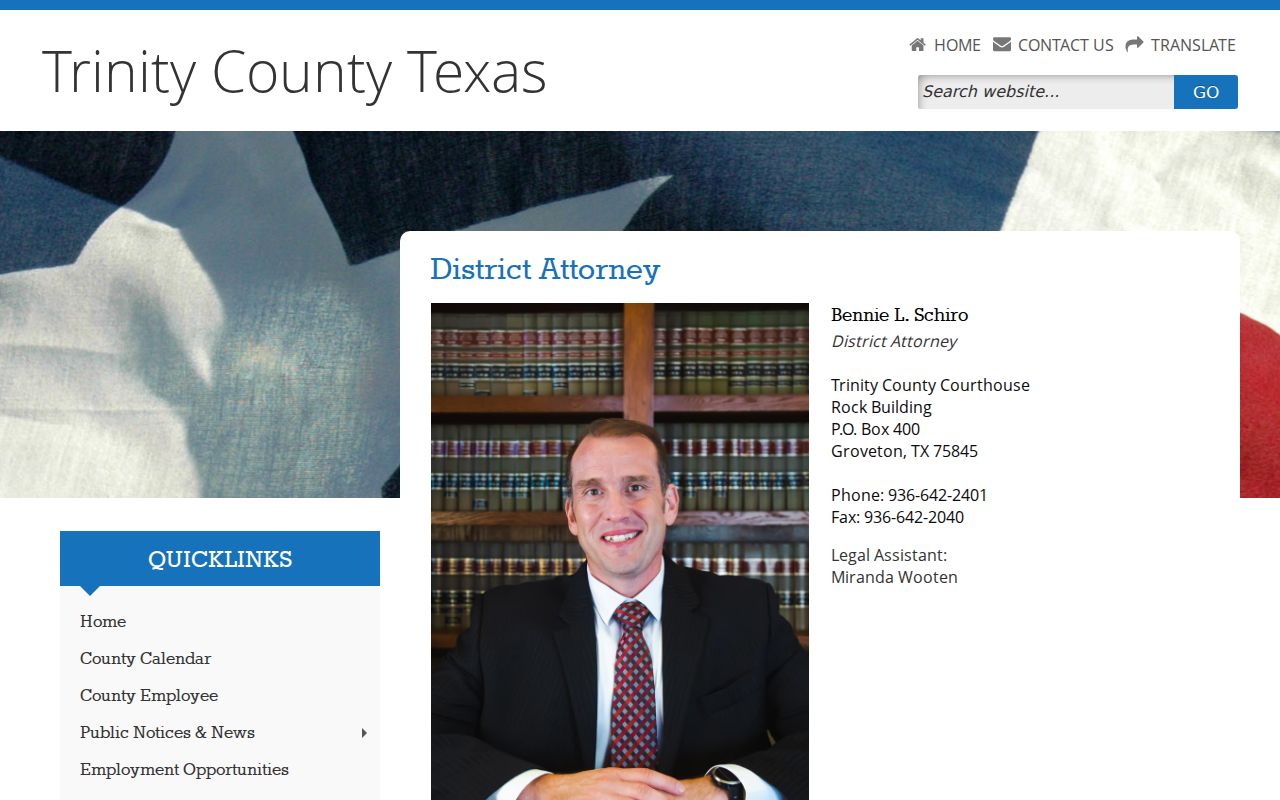
This split explains why an offense report, a prosecutor intake decision, and a filed Trinity County criminal case can show different charge descriptions.
Searching Trinity County Case Records
Start with Trinity County jurisdiction, then use the portal as a discovery tool and the Trinity County clerk as the source of record. Registration, coverage, document access, and charges on re:SearchTX can vary by court. Trinity County also budgets for iDocket services, but that fact does not prove that every Trinity County criminal document is online or free. Follow this sequence:
- Classify the Trinity County matter as felony, county misdemeanor, or fine-only, then identify the Trinity County District Clerk, County Clerk, municipal clerk, or justice court that should hold it.
- Search re:SearchTX by party or cause criteria after registration. Treat any result as a lead until the Trinity County clerk confirms it.
- Use the full name, approximate filing year, court, case type, and cause number when available. Do not invent birth-date filters that the Trinity County court view does not show.
- Open the Trinity County register or docket and read the sequence of filings, settings, pleas, and orders rather than relying on one status label.
- Request the exact paper needed from the Trinity County clerk, and ask whether a plain copy, certified copy, redacted electronic copy, or archive retrieval is available.
The re:SearchTX statewide entry screen for Trinity County shows where the electronic search begins.
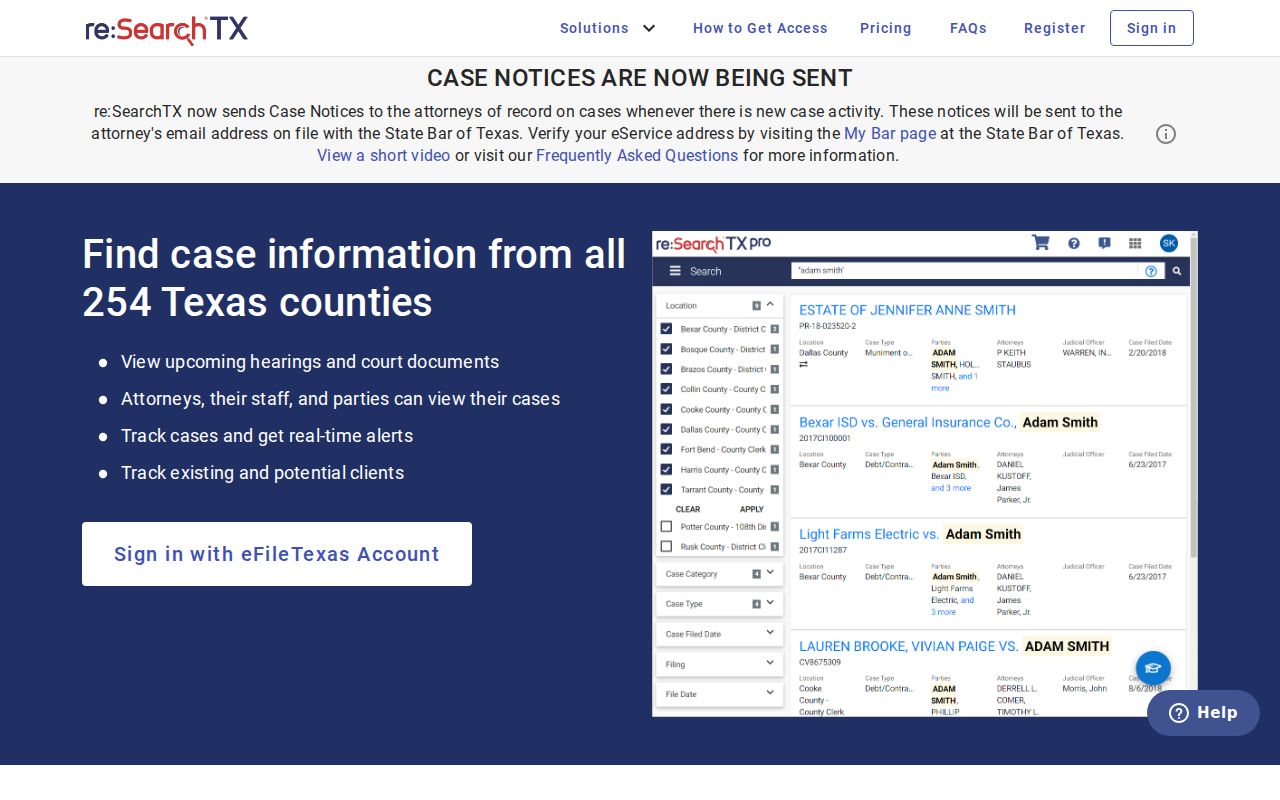
Portal controls can change after login, so the supported Trinity County inventory below stays within the fields documented in the research.
| Field Label | Type | Required | Notes |
|---|---|---|---|
| Person or business | Search mode | Search-dependent | Use for a Trinity County party-name query. |
| Case number | Text | No | Best identifier when the Trinity County cause number is known. |
| Court or location | Select | No | Narrow to the Trinity County court that accepted the filing. |
| Case type | Select | No | Exact Trinity County options depend on court configuration. |
| Filed-date range | Date range | No | Use an approximate Trinity County filing year when the exact date is unknown. |
| Status | Select | No | Verify any label against the Trinity County docket and final order. |
Three Trinity County Court Channels
iDocket-related access, re:SearchTX, and the Trinity County clerk counter serve different needs. A portal can help discover a party match or cause number. The Trinity County clerk can confirm the court, describe archive status, and quote the current copy or retrieval cost. A request by telephone, mail, or in person is still vital when a record is old, paper-based, sealed from public view, or absent from the vendor index.
The Trinity County Clerk warns that the office no longer accepts online payments through, or handles technical problems for, the outside records site. Trinity County government remains the record custodian even when a vendor hosts search or payment functions. Ask the Trinity County clerk whether the file is paper, microfilm, archived, or off-site, then request a written estimate before ordering. No reliable current Trinity County criminal-copy fee was found, so do not assume a web price applies to a certified court record.
Note: A portal match locates a lead; the clerk's file and signed order establish what the Trinity County court actually did.
Inside a Trinity County Case File
A useful Trinity County criminal court file is more than a case-status line. The cause number ties the pieces together. The Trinity County charging paper states what prosecutors filed, the docket maps each event, and the judgment records the result. Ask for documents by name so the clerk can identify a focused set instead of treating the request as an undefined demand for a complete history.
| Cause Number and Court | Identifies the Trinity County case and the district, county, justice, or municipal court that owns it. |
|---|---|
| Charging Document | The complaint, information, or indictment states the charge filed in Trinity County court, which may differ from the booked charge. |
| Docket Entries | List Trinity County filings, hearings, motions, counsel, pleas, settings, and orders in date order. |
| Bond and Settings | Show Trinity County court-set release terms and scheduled proceedings, subject to later change. |
| Disposition and Judgment | Record the Trinity County dismissal, acquittal, conviction, deferred adjudication, or another formal outcome. |
| Sentence and Costs | State the Trinity County court-imposed term, supervision, fine, restitution, and financial ledger where public. |
Birth dates, Social Security numbers, victim or minor identities, and sensitive exhibits may be redacted or restricted even when the main docket is public.
Trinity County Fine-Only Cases
A city ticket does not automatically reach the District Clerk. Trinity Municipal Court keeps city-filed fine-only cases in Trinity, while Groveton Municipal Court keeps its own city docket. Justice courts handle the fine-only matters filed within their county precinct jurisdiction. Searchers should use the citation, filing agency, and place of offense to avoid calling the felony clerk for a municipal record.
The City of Trinity site provides city services and a ticket-payment route.

Payment access is not a full Trinity County criminal case index, so request the Trinity County court's complaint, docket, judgment, or dismissal when proof of outcome is needed.
Groveton publishes more direct local court details through its Municipal Court page.
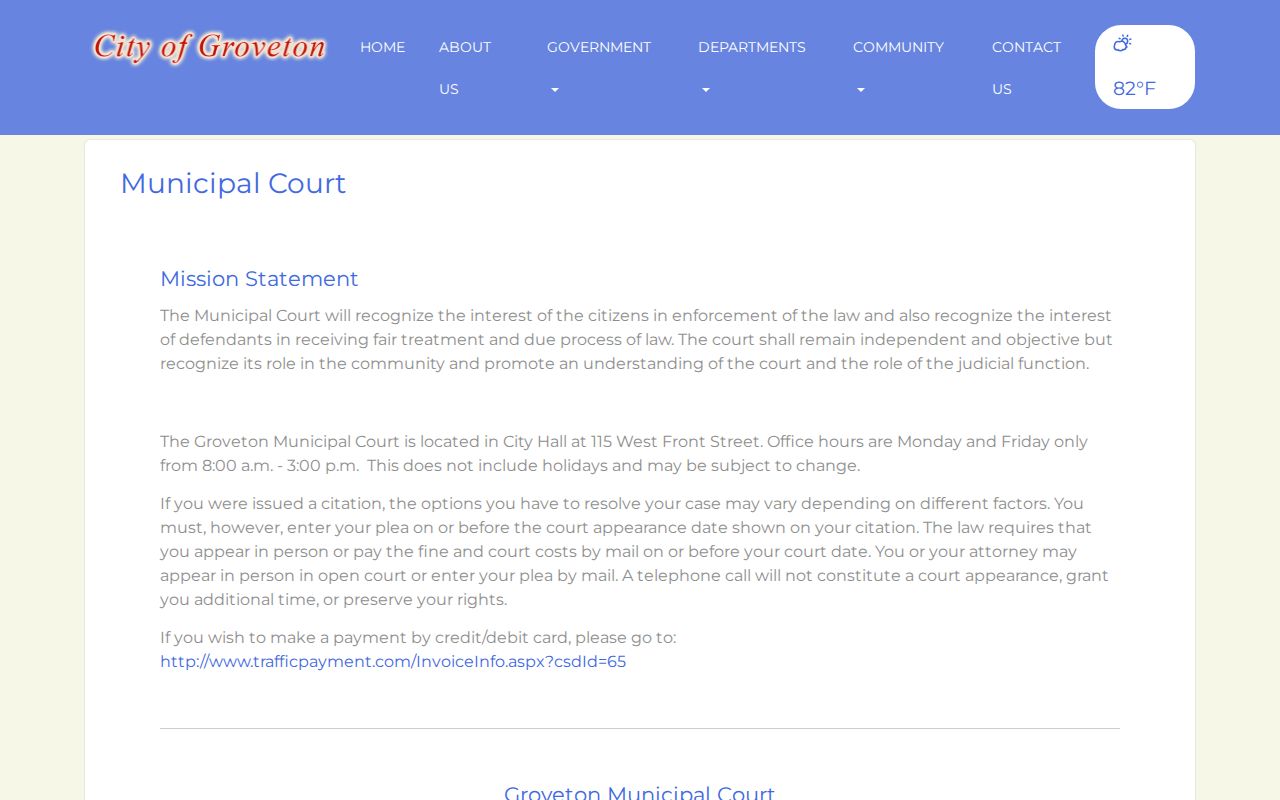
The Groveton court lists City Hall at 115 W. Front Street, P.O. Box 37, Groveton, and warns that a phone call is not an appearance.
How a Criminal Case Moves
A Trinity County court case may start after arrest or summons, but the booked event is not the filed case. Article 15.17 magistration covers initial warnings, probable cause, counsel requests, and bond. The prosecutor then may file an information for an eligible misdemeanor or present a felony to a grand jury. A returned indictment becomes a filed court paper unless sealed, while grand-jury deliberations remain secret.
Case flow: Charges Filed › Arraignment › Pretrial › Plea or Trial › Disposition › Sentencing
Arraignment records the plea. Discovery and motions follow before a negotiated plea or trial. The Trinity County judgment and sentence are the key end-stage papers. An appeal can add a later record, but it does not rewrite the trial clerk's original docket. The Trinity County arrest lookup can establish the earlier booking event, while the court file should be read in order to learn what was filed and resolved.
Trinity County Charges Can Change
An arresting officer records the suspected offense at the custody stage. A Trinity County prosecutor may reject it, change it, add another count, or file no case. That is why the charging instrument carries more weight than the booking label for the court phase. Later still, a plea, dismissal, acquittal, deferred adjudication, or conviction changes how the case ends. The final judgment or dismissal order is the sound source for that outcome.
Terms in the file have distinct meanings. An information is a prosecutor's charging paper, often used for a misdemeanor. An indictment is a grand jury's true bill. A disposition is the case result. Deferred adjudication postpones a finding of guilt during court-ordered supervision. A dismissal ends the filed charge without a conviction, but it does not by itself erase a separate booking record.
Case Record Access and Restrictions
Texas court files are judicial records governed by court rules and specific confidentiality law. They are not simply sheriff records requested under the Texas Public Information Act. Start with the clerk who holds the case. The Texas Judicial Branch rules and standards provide the statewide access framework, while other laws protect juvenile material, victim and minor data, confidential identifiers, sealed files, expunged cases, and records covered by nondisclosure.
An online view may omit a protected field while the public part of the Trinity County docket remains available. Ask the clerk for the legal basis when material is restricted and whether a segregable, redacted copy can be released. A missing portal result can also mean the file is not digitized, the court is not participating at that level, or the search criteria do not match. It is not proof that no Trinity County criminal court case exists.
Federal Cases Beyond Trinity Courts
Trinity County lies within the U.S. District Court for the Eastern District of Texas. Federal criminal dockets do not sit with the Trinity County District Clerk or County Clerk. They are searched through PACER, which requires an account and follows the federal judiciary's current fee rules. A local county search therefore cannot disprove the existence of a federal case.
The official PACER case-search channel is the proper federal starting point.
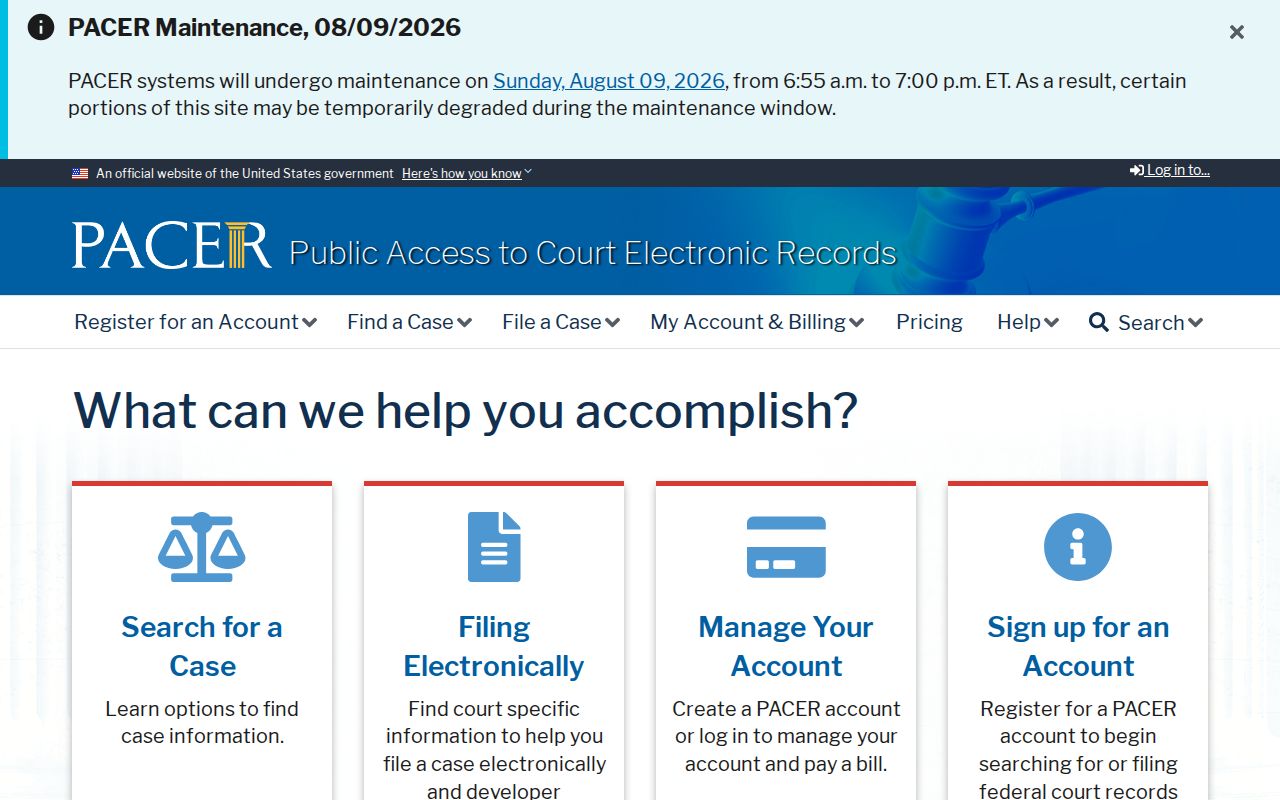
PACER cannot replace a Trinity County arrest report or Trinity County court judgment, just as a local clerk cannot certify a federal docket entry.